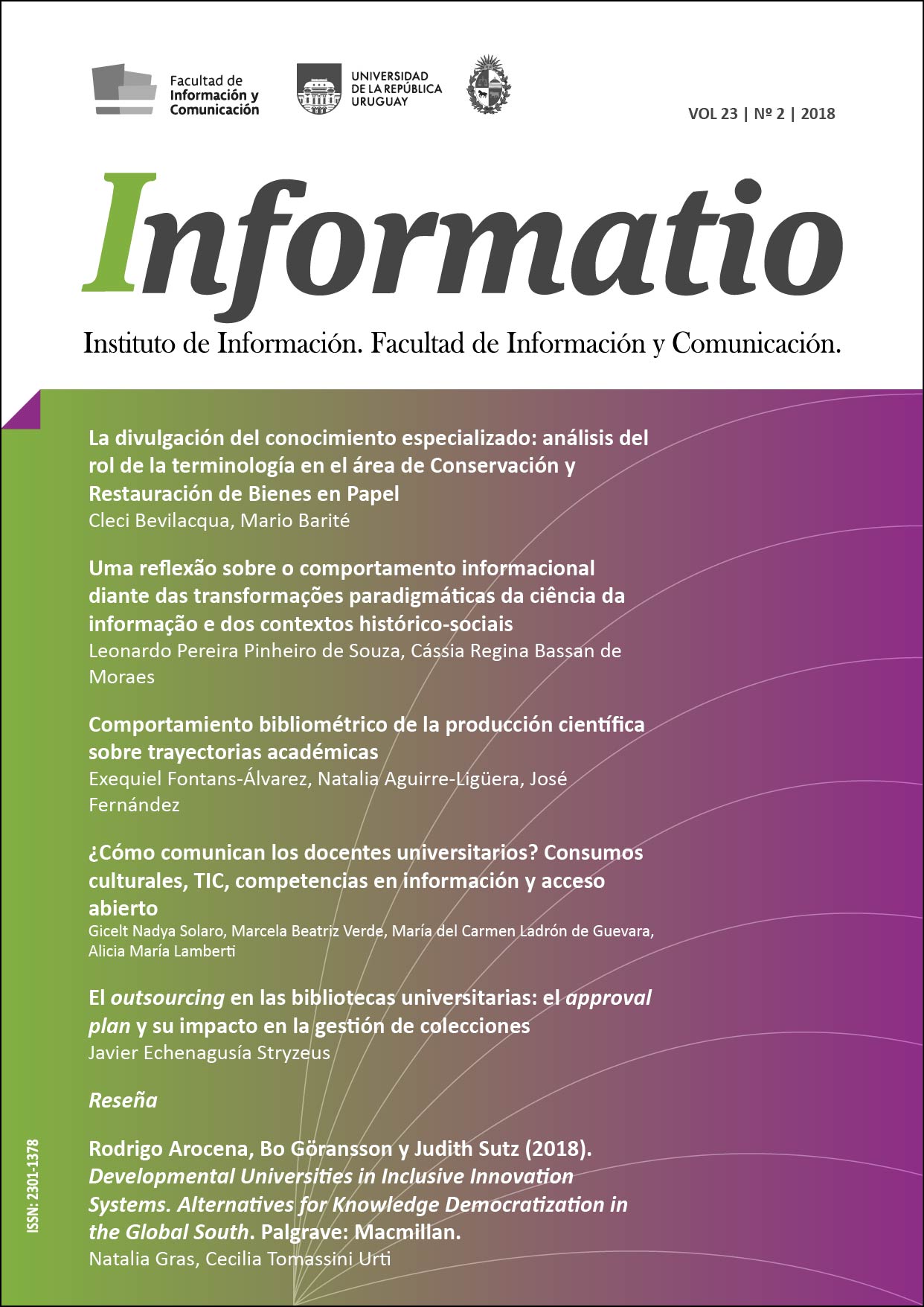
A reflexion about the information behavior in face of the paradigmatic transformations of information science and historical-social contexts
Abstract
This paper is a literature review, aiming to discuss the changes of perspectives in Information Science, caused by historical, social and economic variables that influenced it, as well as the information user studies. It is considered three historical moments following the Second World War, until the 21st century, in the context of the paradigms defined by Capurro: the physical, the cognitive and the social. Through an interdisciplinary perspective, papers in Information Science, Philosophy, Sociology and Engineering fields were analyzed, pursuing a holistic view. This work presents its originality in the interdisciplinarity and analysis of historical, political and economic transformations as determinants in the priorities of the information user studies. It concludes by emphasizing that the advent of the information society alone has not been able to bring the development and improvement of living conditions, especially in poor countries, and that information professionals, as agents serving the public interest, should support social transformation by assisting individuals in the effective use of information. Therefore, user studies are essential to understand and satisfy information needs, aiming at the transformation of social reality, if they have a consistent theoretical foundation.
Downloads
References
Allcott, H. & Gentzkow, M. (2017). Social media and fake news in the 2016 election. Journal of Economic Perspectives, 31( 2), 211- 236. Recuperado de: https://pubs.aeaweb.org/doi/pdfplus/10.1257/jep.31.2.211.
Araújo, C. A. A. (2009). Correntes teóricas da ciência da informação. Ciência da Informação, 38(3), 192-204. Recuperado de: http://www.scielo.br/pdf/ci/v38n3/v38n3a13.pdf.
Araújo, I. L. (2012). Curso de teoria do conhecimento e epistemologia. Barueri: Minha Editora.
Beaumont, P. (2011, fevereiro 25). The truth about Twitter, Facebook and the uprisings in the Arab world. The Guardian, World, Middle East. Recuperado de: https://www.theguardian.com/world/2011/feb/25/twitter-facebook-uprisings-arablibya.
Belkin, N. J. (2005). Anomalous State of Knowledge. In: K. E. Fischer, S. Erdelez & L. McKechnie, L. (Eds.). Theories of information behavior. Medford (NJ), Information Today, pp. 44- 48.
Borko, H. (1968). Information Science: What is it? American Documentation, 19(1), 3- 5. Recuperado de: https://edisciplinas.usp.br/pluginfile.php/3433774/mod_resource/content/1/Oque%C3%A9CI.pdf.
Bufrem, L. S. (2013). Configurações da pesquisa em Ciência da Informação.
DataGramaZero, 14 (6), 1- 13. Recuperado de: http://www.brapci.inf.br/index.php/article/download/50777.
Bush, V. (1996). As we may think. Interactions, 3 (2), 35- 46. Recuperado de: https://dl-acm-org.ez87.periodicos.capes.gov.br/citation.cfm?id=227186.
Cadwalladr, C. & Graham-Harrison, E. (2018, março 17). Revealed: 50 million Facebook profiles harvested for Cambridge Analytica in major data breach. The Guardian, News. Recuperado de: https://www.theguardian.com/news/2018/mar/17/cambridge-analytica-facebookinfluence-us-election.
Candiotto, C. (2012). Neoliberalismo e democracia. Princípios, 19 (32), 153- 179. Recuperado de: https://periodicos.ufrn.br/principios/article/view/7568/5631.
Capurro, R. (2007). Epistemología y ciencia de la información. Enl@ce, 4 (1), 11-29. Recuperado de: http://www.redalyc.org/articulo.oa?id=82340102.
Chiavenato, I. (2003). Introdução à teroria geral da administração: uma visão abrangente da moderna administração das organizações (7. ed). Rio de Janeiro: Elsevier.
Choo, C. W. (2003). A organização do conhecimento: como as organizações usam a informação para criar significado, construir conhecimento e tomar decisões. São Paulo: SENAC.
Dervin, B. (2005). What methodology does to theory: sense-making methodology as exemplar. In S. E. Fischer, S. Erdeles & L. McKechnie (Eds.), Theories of Information behavior (Cap. 2, pp. 25- 29). Medford (NJ): Information Today.
Detlor, B. (2005). Web information behaviors of organizational workers. In: , K. E. Fisher, S. Erdelez & L. McKechine. (Eds.), Theories of information behavior (Cap. 68, pp. 377-381). Medford (NJ): Information Today.
Ellis, D. (1989). A behavioural approach to information retrieval system Design. Journal of Documentation, 45 (3), 171- 212. Recuperado de: https://doi.org/10.1108/eb026843.
Ellis, D. (2005). Ellis’s model of information behavior. In K. E. Fisher, S. Erdelez & L. McKechine (Eds.). Theories of information behavior (Cap. 21, pp. 138-142). Medford (NJ), Information Today.
Fan, S., Lau, R. Y. K. & Zhao, J. L. (2015). Demystifying big data analytics for business intelligence through the lens of marketing mix. Big Data Research, 2(1), 28- 32. Recuperado de: http://www.sciencedirect.com/science/article/pii/S2214579615000155#.
González-Teruel, A. (2005). Los estudios de necesidades y usos de la información: fundamentos y perspectivas actuales. Guijón (Asturias): Ediciones Trea.
Hjørland, B. (2002). Epistemology and the socio-cognitive perspective in Information Science. Journal of the American Society for Information Science and Technology, 53(4), 257–270. Recuperado de: http://onlinelibrary.wiley.com/doi/10.1002/asi.10042/epdf.
Hjørland, B. (2005). The socio-cognitive theory of users situated in specific contexts and domains. In K. E. Fisher, S. Erdelez & L. McKechine (Eds.).
Theories of information behavior (Cap. 60, pp. 339- 343). Medford (NJ), Information Today.
Kuhlthau, C. C. (2005). Kuhlthau’s information search process. In K. E. Fisher, S. Erdelez & L. McKechine (Eds.). Theories of information behavior (Cap. 38, pp 230- 234). Medford (NJ), Information Today.
Lévy, P. (1998). A inteligência coletiva: por uma antropologia do ciberespaço. São Paulo: Edições Loyola.
Lima, A. (2013). Excurso sobre o conceito de contracultura. Holos, 29(4), 189-192. Recuperado de: http://www2.ifrn.edu.br/ojs/index.php/HOLOS/article/view/1536/715.
Palley, T. I. (2005). Del keynesianismo al neoliberalismo: paradigmas cambiantes en economía. Economía UNAM, 2 (4), 138- 148. Recuperado de: http://www.scielo.org.mx/scielo.php?pid=S1665-952X2005000100007&script=sci_arttext.
Pombo, O. (2005). Interdisciplinaridade e integração dos saberes. LIINC em Revista, 1(1), 3- 15. Recuperado de: http://revista.ibict.br/liinc/article/view/3082/2778.
Rendón-Rojas, M. A. (1996). Hacia un nuevo paradigma en Bibliotecologia. Transinformação, 8 (3), 17- 31. Recuperado de: http://periodicos.puccampinas.edu.br/seer/index.php/transinfo/article/viewFile/1598/1570.
Rendón-Rojas, M. A. (2001). Un análisis del concepto sociedad de la información desde el enfoque histórico. Información, Cultura y Sociedad, 4, 9-21. Recuperado de: http://www.scielo.org.ar/pdf/ics/n4/n4a02.pdf.
Rendón-Rojas, M. A. (2005). Relación entre los conceptos: información, conocimiento y valor. Semejanzas y diferencias. Ciência da Informação, 34 (2), 52- 61. Recuperado de: http://www.scielo.br/pdf/%0D/ci/v34n2/28555.pdf.
Rendón Rojas, M. A. (2007). Los valores sociales y políticos dentro del paradigma bibliotecológico en la era de la información. Transinformação, 19 (1), 9- 18. Recuperado de: http://www.redalyc.org/pdf/3843/384334745001.pdf.
Rendón-Rojas, M. A. & Hernández-Salazar, P. (2010). Sense–making: ¿metateoría, metodología o heurística? Investigación Bibliotecológica, 24(50), 61-81. Recuperado de: http://www.scielo.org.mx/pdf/ib/v24n50/v24n50a5.pdf.
Robredo, J. (2011). Do documento impresso à informação nas nuvens: reflexões. Liinc em Revista, 7 (1), 19- 42. Recuperado de: http://revista.ibict.br/liinc/article/view/3287/2903.
Rodríguez-Gallardo, A. (2004, dezembro).¿Qué evaluar de los sistemas de información al servicio de la sociedad?. Coloquio Internacional de Bibliotecarios, Guadalajara, Jalisco, México, 11. Recuperado de: http://148.202.105.23/coloquio/memorias/XI%20CIB%202004.pdf#page=115.
Rodríguez-Gallardo, A. (2005).Lectura e internet: dos tecnologías. Investigación Bibliotecológica, 19 (38), 11- 32. Recuperado de: http://www.scielo.org.mx/pdf/ib/v19n38/v19n38a2.pdf.
Saracevic, T. (1999). Information Science. Journal of the American Society for Information Science, 50 (12), 1051- 1063. Recuperado de: http://onlinelibrary.wiley.com/doi/10.1002/(SICI)1097-4571(1999)50:12%3C1051::AID-ASI2%3E3.0.CO;2-Z/abstract.
Savolainen, R. (1995). Everyday life information seeking: Approaching information seeking in the context of “way of life”. Library & Information Science Research, 17 (3), 259- 294. Recuperado de: https://doi.org/10.1016/0740-8188(95)90048-9.
Shannon, C. E. (2001). A mathematical theory of communication. ACM SIGMOBILE Mobile Computing and Communications Review, 5 (1), 03- 55. Recuperado de: https://dl.acm.org/citation.cfm?id=584093.
Shera, J. (1977). Epistemologia social, semântica geral e biblioteconomia. Ciência da Informação, 6 (1), 9- 12. Recuperado de: http://revista.ibict.br/ciinf/article/view/92/92.
Spink, A. & Case, D. O. (2012). Looking for information (3. ed). Bingley: Emerald.
Stone, I. F. (1998). O julgamento de Sócrates. São Paulo: Companhia das Letras.
Villaseñor-Rodríguez, I.(2008). Propuesta metodológica para un estudio de usuarios de documentación filosófico-jurídica. Documentación de las Ciencias de la Información, 31, 237- 257. Recuperado de: http://revistas.ucm.es/index.php/DCIN/article/viewFile/DCIN0808110237A/18928.
Villaseñor-Rodríguez, I.(2013). El fenómeno de las necesidades de información en España. In J. J. Calva-González (org.), Usuarios de la información en diferentes comunidades académicas y sociales: investigaciones (cap. 2, pp. 23-36). México (DF): UNAM - Instituto de Investigaciones Bibliotecológicas y de la información. Recuperado de: https://s3.amazonaws.com/academia.edu.documents/36857690/usuarios_informacion_comunidades_academicas.pdf?AWSAccessKeyId=AKIAIWOWYYGZ2Y53UL3A&Expires=1537806250&Signature=N4SSxMZhCKzJho7liiXf5YVpkvY%3D&response-contentdisposition=inline%3B%20filename%3DLibro_Usuarios_de_la_informacion_en_dife.pdf#page=34
Villaseñor-Rodríguez, I.(2015). Los usuarios 2.0 y las nuevas estrategias para la identificación de las necesidades de información. Bibliotecas, 33 (2), 1-10. Recuperado de: http://www.revistas.una.ac.cr/index.php/bibliotecas/article/view/7521/7838.
Copyright (c) 2019 Leonardo Pereira Pinheiro de Souza, Cássia Regina Bassan de Moraes

This work is licensed under a Creative Commons Attribution 4.0 International License.




.png)